
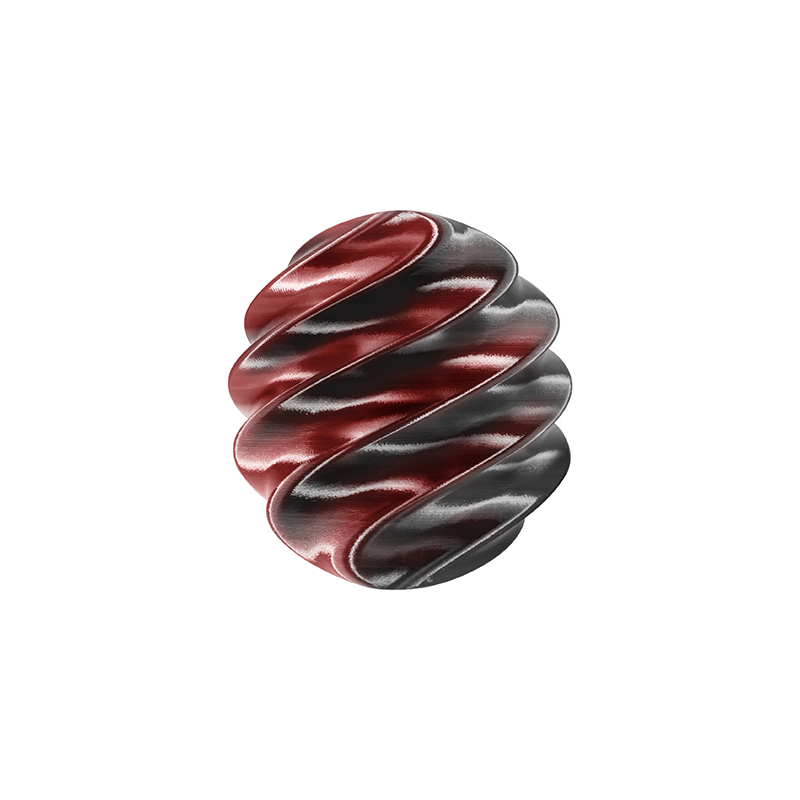
Many makers choose tricolor silk PLA because it produces colorful surfaces with a smooth metallic-like appearance while remaining easy to print. However, the consistency of that luster depends on more than the visible color transition. Material formulation, pigment compatibility, extrusion stability, and manufacturing control all influence the final result. Understanding these factors helps users select tri color PLA filament that performs reliably across different printing projects.
Why Material Formulation Matters for tricolor silk PLA
The metallic-looking finish of tricolor silk PLA is not created by metal particles. Instead, manufacturers typically combine PLA with carefully selected polymer modifiers that improve surface smoothness and light reflection. These additives help printed layers appear glossy without significantly changing the printing process.
The formulation must also keep sufficient flow stability. If additives are not evenly distributed, the surface may show uneven gloss or inconsistent color transitions. A balanced material blend allows every layer to reflect light in a similar way, producing a more uniform appearance.
The Role of Polymer Compatibility in Surface Gloss
A consistent luster depends on how well every component mixes during compounding. The PLA base resin, gloss-enhancing modifiers, color concentrates, and processing aids should remain compatible throughout extrusion.
When incompatible materials are blended together, microscopic separation may occur inside the filament. During printing, these differences can create dull areas or irregular reflections. Careful material selection helps maintain an even surface finish from the beginning to the end of a spool.
How Pigment Quality Influences Metallic Appearance
Color is another important factor behind metallic-looking prints. High-quality pigments disperse more evenly throughout the material, allowing the printed object to maintain balanced color transitions while preserving gloss.
Pigment particle size also affects light reflection. Uniform particles reduce visual inconsistencies between printed layers. For multicolor products, manufacturers need stable pigment systems so that each color retains similar reflective characteristics rather than appearing brighter or flatter than neighboring colors.
Stable Extrusion Keeps tri color PLA filament Consistent
Even an excellent material blend can lose its visual advantages if the extrusion process is unstable. Temperature control, screw design, and cooling conditions all influence filament diameter and internal structure.
When extrusion remains consistent, the additives and pigments stay evenly distributed across the filament cross-section. This supports stable melting behavior during printing, helping the finished model display a more continuous glossy appearance. For users purchasing tri color PLA filament, manufacturing consistency is therefore as important as the material recipe itself.
Manufacturing Quality Reduces Visual Variation
Quality control extends beyond raw materials. Diameter tolerance, moisture management, and spool winding all contribute to reliable printing performance.
Moisture can affect surface quality because excessive water may create tiny bubbles during extrusion or printing. Controlled drying before packaging helps preserve smooth extrusion and supports a cleaner finish. Consistent winding also allows the filament to feed smoothly, reducing interruptions that could influence layer appearance.
Why Raw Material Selection Makes a Difference
The quality of the base PLA resin establishes the foundation for both printability and surface finish. Reliable suppliers provide resin with stable molecular properties, helping manufacturers achieve repeatable processing results.
Based on this principle, CaiLab explains that they select raw materials from internationally recognized suppliers, including NatureWorks in the United States, to maintain stable material properties. Consistent raw materials help reduce diameter variation and minimize printing performance fluctuations that may affect the visual quality of multicolor filaments.
Large-Scale Testing Improves Formula Refinement
Developing multicolor materials requires repeated verification rather than relying only on laboratory evaluation. Printing tests under practical conditions reveal how the material behaves during long production cycles and across different model geometries.
With this testing foundation, CaiLab can evaluate newly developed filament formulations through continuous production testing. CaiLab operates a large internal printing farm with approximately 2,000 printers. Its large testing capacity enables repeated verification under consistent printing conditions. Large-volume verification helps identify formulation adjustments that support stable extrusion, smoother surfaces, and more consistent color performance before products reach users.
Material Blend and Co-Extrusion Work Together
A balanced material blend performs best when combined with a stable co-extrusion process. During production, multiple color streams must maintain consistent flow so that the glossy surface remains uniform across changing colors. CaiLab offers a multicolor PLA filament with a 1.75 mm diameter and a 1 kg spool. Its three-color structure is designed for smooth transitions, while the formulation ensures that each layer reflects light consistently throughout printing.
Material Properties Are Preserved Through Proper Printing
Even a well-developed material blend benefits from suitable printing conditions. Stable nozzle temperatures, consistent extrusion, and dry filament storage help preserve the smooth surface created by the formulation. These practices allow the balanced resin system, pigments, and gloss-enhancing additives to perform as intended, making it easier for tri color PLA filament to maintain the metallic-like appearance expected from tricolor silk PLA.
Choosing Materials Based on Reliable Manufacturing
When evaluating tri color PLA filament, users should consider more than attractive product photos. The overall manufacturing process—including raw material quality, formulation development, production consistency, and practical testing—has a direct impact on the finished print.
For tricolor silk PLA, metallic-like luster consistency comes from a balanced combination of compatible PLA materials, carefully dispersed pigments, gloss-enhancing modifiers, stable extrusion, and thorough quality verification. CaiLab supports these goals through controlled raw material selection, extensive print testing, and multicolor filament designs that help users achieve reliable decorative printing results.