
A competitive equipment quote is only valuable when the machine can meet a project’s access requirements, operating conditions, and productivity targets. For contractors, rental companies, and equipment distributors, comparing prices without examining technical specifications can lead to unexpected costs or unsuitable equipment.
A thorough evaluation of a telescopic boom lift should consider working height, horizontal outreach, platform capacity, terrain capability, maintenance requirements, and the scope of the supplier’s offer. These factors help buyers compare equipment on operational value rather than purchase price alone.
Compare Working Height and Horizontal Outreach
Working height is an important starting point, but it does not tell the whole story. Buyers should distinguish maximum working height from platform height and horizontal outreach. Working height describes the maximum height a worker can reach, while outreach indicates how far the platform can extend horizontally from the machine’s working position.
For projects involving steel structures, industrial facilities, or large construction sites, insufficient outreach may force crews to reposition equipment frequently. Buyers should review the manufacturer’s operating envelope to confirm that the machine can reach the required work area without exceeding its permitted operating limits.
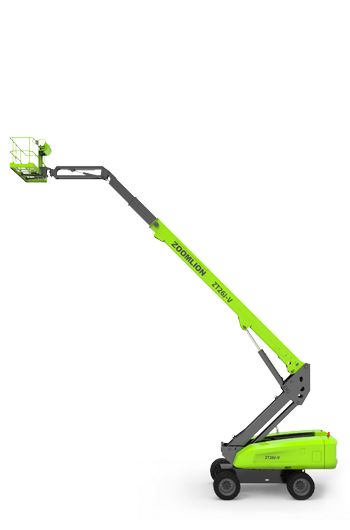
The Zoomlion Access ZT26J, for example, has a published maximum working height of 28.7 meters, a platform height of 26.7 meters, and horizontal outreach of 22.1 meters. These figures provide a practical basis for comparing models intended for elevated outdoor work.
Check Platform Capacity Under Real Working Conditions
Platform capacity determines how much weight the machine can safely carry. Buyers should account for workers, tools, materials, and any additional equipment that will be present during operation. A higher capacity can support demanding tasks, but only when the machine’s permitted operating configuration allows it.
The ZT26J offers dual platform capacities of 300 kg unrestricted and 454 kg restricted. These ratings are not interchangeable: the permitted load depends on the boom’s operating position and the applicable load restrictions. Procurement teams should check the load chart and operating manual before matching a machine to a specific task.
When comparing quotes, buyers should verify that each supplier is offering a machine with suitable capacity for the intended work. A lower-priced model may be unsuitable if its load limits require additional trips or different work procedures.
Evaluate Terrain Performance and Machine Dimensions
Outdoor construction sites often contain uneven surfaces, slopes, loose ground, and restricted access routes. In these conditions, drive configuration, gradeability, ground clearance, tire type, and chassis dimensions can influence whether a machine is practical for the job.
The ZT26J features four-wheel drive, a published gradeability of 45% (24°), and 0.40 m of ground clearance. Its listed stowed dimensions are 11.91 m long, 2.49 m wide, and 2.82 m high. These specifications help buyers assess access requirements, transport arrangements, and maneuverability.
However, gradeability should not be confused with permission to operate on a slope while elevated. Actual operating limits depend on the manufacturer’s instructions, ground conditions, and machine configuration. Buyers should also confirm whether the site requires solid tires, foam-filled tires, or another approved option.
For fleet managers comparing a telescopic boom lift with competing models, these details can reveal differences that headline reach figures and purchase prices fail to capture.
Compare Power Systems and Operating Costs
Diesel-powered machines are often considered for outdoor projects where long operating periods, mobility, and access to charging infrastructure influence equipment selection. However, fuel consumption, maintenance schedules, engine configuration, and expected utilization should all be included in the cost comparison.
Buyers should request information about routine servicing, replacement parts, warranty coverage, and access to technical support. A quote that excludes essential servicing or assumes different usage conditions may not provide a fair comparison with another supplier’s offer.
The ZT26J’s published features include a load-sensitive system designed to save energy, a parallel four-link lifting mechanism for smooth boom movement, and a deadweight lowering system intended to support smooth operation and energy efficiency. Its upgraded telematics are designed to improve service efficiency. Buyers can assess how these features align with their maintenance processes and operating requirements.
Examine Safety Features and Compliance Documentation
Safety provisions deserve the same attention as performance specifications. Procurement teams should confirm applicable certification requirements, emergency lowering arrangements, platform controls, operating alarms, and the availability of the correct manuals.
The ZT26J product page identifies CE/ANSI/CSA certification. Buyers should nevertheless verify the documentation and applicable standards for the particular model, destination market, and intended application rather than assume that one certification automatically satisfies every local requirement.
When evaluating telescopic aerial platforms manufacturers, purchasing teams should also ask how operators will receive training, how inspection requirements are addressed, and where authorized service support is available. Clear answers help reduce uncertainty after delivery and support consistent fleet management.
Compare Suppliers on Total Value, Not Just Price
A reliable comparison requires equivalent specifications and clearly defined commercial terms. Buyers should request itemized quotations covering the machine configuration, standard equipment, optional accessories, delivery, warranty, training, and after-sales service. Lead times, payment conditions, spare-parts availability, and regional support arrangements should also be recorded.
Different telescopic aerial platforms manufacturers may quote different configurations under similar model descriptions. Before comparing totals, procurement teams should confirm that working height, outreach, capacity, tires, powertrain, and included accessories match the project requirements.
Zoomlion Access provides the diesel-powered ZT26J for demanding outdoor access applications. Its product information outlines the model’s reach, dual-load capacity, terrain-related specifications, and operating features, giving buyers a concrete reference for technical evaluation. Contractors and rental businesses can use the published data as a starting point when requesting a detailed, project-specific quotation.
Make Every Quote Match the Job
The strongest purchasing decision comes from balancing technical suitability, operating costs, safety requirements, and supplier support. Buyers should establish a clear specification checklist before requesting offers, then compare each quotation against the same operational criteria.
For contractors, rental companies, and distributors assessing telescopic aerial platforms manufacturers, this process helps distinguish genuine value from a low initial price. By checking reach, load capacity, terrain capability, maintenance provisions, and commercial terms, buyers can select equipment that better fits project demands. The Zoomlion Access ZT26J offers one reference point for this evaluation, but the final choice should always reflect verified specifications and the actual conditions of the job.