
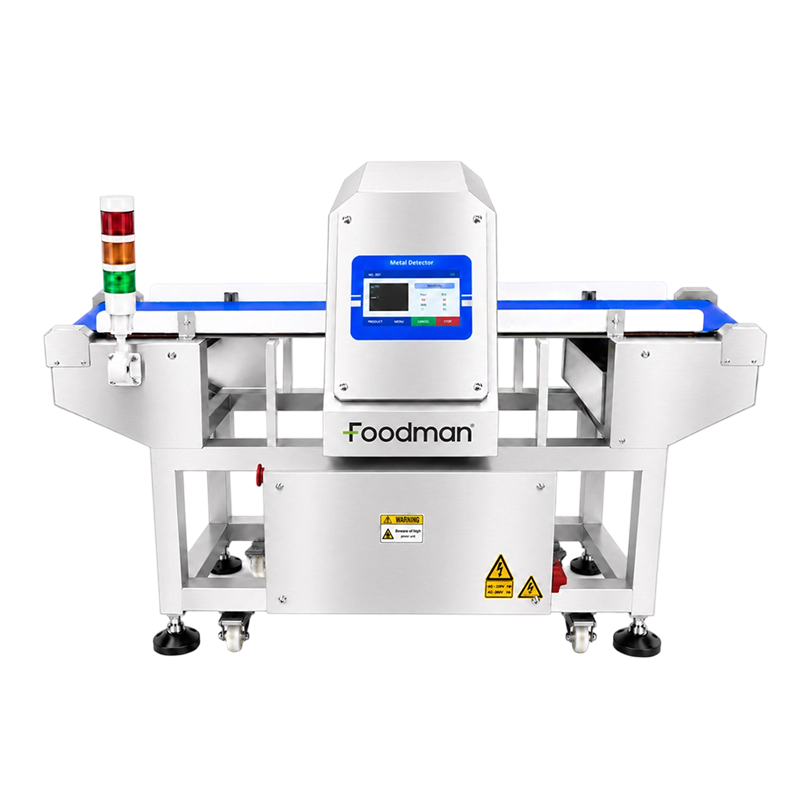
Meat processors face increasing pressure to demonstrate that contamination control is not only effective but also documented and verifiable. Retail customers, export markets, and food safety auditors expect evidence that inspection equipment is properly validated, routinely checked, and integrated into a formal quality system. A food metal detector for meat processing therefore serves two purposes: protecting product quality and supporting compliance with food safety standards. Foodman Vision addresses both through application-specific system design, OEM/ODM customization, and B2B service support.
Aligning Metal Detection With HACCP and Retailer Standards
Most meat processors operate under HACCP plans that identify metal contamination as a significant hazard. The metal detector is typically treated as a critical control point, which means its performance must be monitored, verified, and documented. A food metal detector that cannot produce reliable records may create compliance gaps even if its detection sensitivity is adequate.
Retailer standards often go further than regulatory requirements. Some buyers specify particular test frequencies, test piece materials, and rejection verification procedures. Foodman Vision can configure inspection systems to store product-specific settings and export inspection data, making it easier to meet these documentation expectations during customer audits.
In practice, the CCP designation means that any deviation—such as a failed verification check or an unrecorded rejection—must be treated as a potential food safety event. Having a clear written procedure for what to do when a check fails, including product hold and re-inspection steps, is just as important as the detector itself.
Validation and Verification: Meeting Audit Requirements
Validation confirms that the equipment can detect the relevant contaminants under real production conditions. Verification confirms that it continues to do so over time. Both activities require representative test samples, defined procedures, and records that auditors can review.
For meat products, test samples should reflect the actual product composition, temperature, and packaging. A test piece embedded in a surrogate material may not produce the same signal as one embedded in chilled minced meat or a brined sausage. Foodman Vision supports sample testing before purchase and provides guidance on ongoing verification protocols after installation.
Documenting Rejection Events and Traceability
Every rejection event carries information. The time, product type, shift, and suspected source can help quality teams identify patterns. A food metal detector that records and exports this data allows processors to investigate recurring issues rather than treating each rejection as an isolated incident.
Traceability also matters during recalls or customer complaints. If a metal fragment is found downstream, inspection records can help determine whether the contamination passed through the detector or originated after inspection. Foodman Vision’s systems can be configured to store inspection logs and integrate with existing quality management platforms, supporting faster and more accurate traceability investigations.
Rejection records are most useful when they can be linked to specific batches or lots. If the detector’s data can be matched to production records, quality teams can quickly narrow down which products are affected and avoid broad recalls that would otherwise be necessary.
Training Operators and Standardizing Response Procedures
Technology alone does not ensure compliance. Operators need clear procedures for running verification checks, responding to alarms, and documenting results. A food metal detector is only as reliable as the people operating it and the procedures they follow.
Foodman Vision provides operator training as part of its B2B service package. This includes guidance on test piece handling, reject confirmation, and record keeping. For processors running multiple shifts, standardized procedures help maintain consistency across operators and reduce the risk of undocumented deviations.
Integrating Metal Detection With Other Quality Controls
Metal detection rarely works alone in a meat plant. X-ray inspection, checkweighing, vision systems, and manual checks may all contribute to the broader quality program. A Food metal detector should be positioned and configured so that it complements these other controls rather than duplicating or conflicting with them.
Foodman Vision offers OEM and ODM services for meat processors, including conveyor integration, reject mechanism selection, and data output customization. For B2B customers, this means the inspection system can be adapted to existing line layouts, hygiene requirements, and quality workflows. Sample testing before delivery helps confirm that the chosen configuration meets both detection and compliance objectives.
When multiple inspection technologies are used on the same line, their sequence should be planned carefully. Inspecting with X-ray before metal detection, for example, may allow one system to catch certain contaminants while the other focuses on different risks. Coordinating these checkpoints reduces redundant handling and keeps the overall quality process efficient.
Conclusion
For meat processors, metal detection is not only a technical function but also a compliance obligation. Validation, verification, documentation, training, and traceability all contribute to a defensible food safety program. A food metal detector that supports these activities—through reliable detection, data logging, and adaptable configuration—helps processors meet auditor expectations and customer requirements. Foodman Vision applies this compliance-oriented approach to meat inspection, combining OEM/ODM flexibility with B2B service support so that the equipment fits both the production line and the quality system around it.