
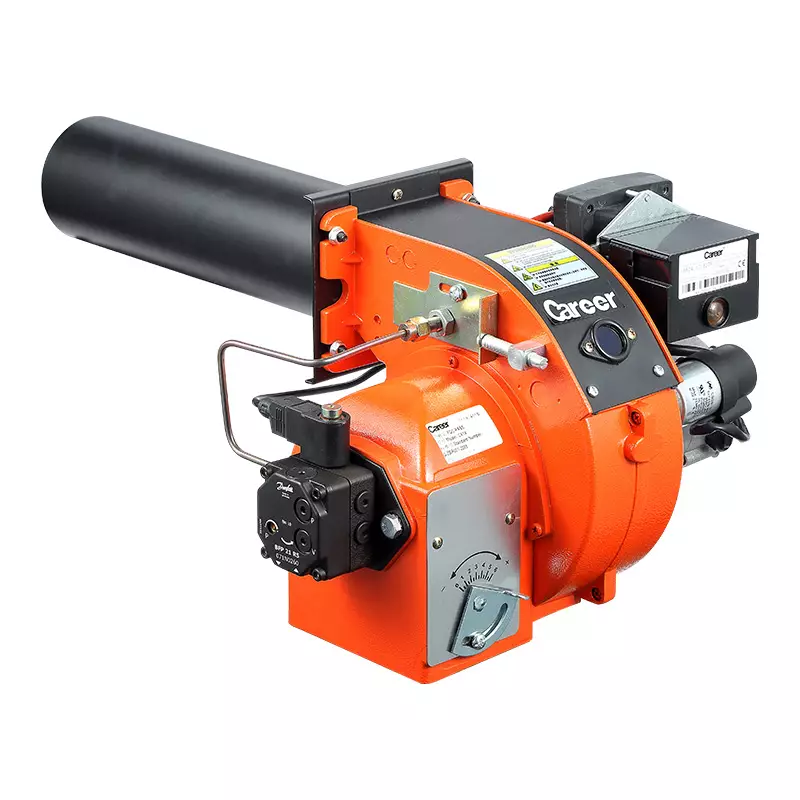
Fuel consumption in an industrial burner is not determined by the burner alone. The amount of diesel required depends on the heat demand of the equipment, furnace pressure, fuel delivery, air supply, combustion condition, and the operating range of the burner. Even a burner with a published consumption figure can use a different amount of fuel after installation because the connected furnace creates its own operating conditions.
The CX14 provides a clear example. Its oil consumption is 7.5–14.5 kg/hr, while its output power is 89–172 kW. The manufacturer specifically notes that the actual fuel-consumption range depends on furnace pressure.
Why Is Fuel Consumption Not a Fixed Number?
Furnace pressure is one of the most direct variables identified in the CX14 documentation. Pressure inside the combustion chamber affects the conditions under which the burner operates, so the published consumption range should be understood as a reference rather than an identical rate for every installation.
Heat demand creates another variable. A process requiring less heat will generally require less fuel than one operating at a higher thermal load. The burner therefore needs to operate at an appropriate point within its available range rather than continuously treating maximum output as the normal operating requirement.
The CX14 is specified for 76,500–147,900 kcal/h of heat power. That range illustrates why fuel consumption and thermal output should be considered together. Comparing consumption alone can give an incomplete picture of how much useful heat the system is producing.
How Do Atomization and Air Supply Change Consumption?
Liquid fuel has to be prepared properly before combustion. The CX14 uses high-pressure mechanical atomization, which is the method identified on its product page for delivering fuel into the combustion process. Effective atomization supports the formation of a suitable fuel-air mixture and contributes to stable combustion conditions.
Air delivery is equally important. A diesel burner needs an appropriate relationship between fuel input and combustion air. Too little air can hinder complete combustion, while excessive air can increase the quantity of heated gas leaving through the exhaust. The CX14 therefore incorporates an integrated airflow regulator as part of its design.
The practical implication is that fuel flow cannot be evaluated independently of air flow. A burner may receive the correct quantity of diesel, yet combustion can still become inefficient if the air supply does not suit the operating condition. Proper adjustment keeps the combustion process closer to its intended operating condition.
What Role Does Burner Capacity Play?
Capacity affects fuel consumption because the burner must supply enough heat without being fundamentally mismatched with the heating equipment. The CX14’s output range of 89–172 kW corresponds with its stated oil-consumption range of 7.5–14.5 kg/hr.
Oversizing and undersizing can both create operating problems. A burner with insufficient capacity may need to operate near its upper limit for extended periods. An unnecessarily large burner, meanwhile, may not operate at a suitable point for the actual thermal demand. Burner sizing guidance from Career Burner emphasizes matching capacity with actual load requirements and considering combustion-chamber characteristics rather than relying on output alone.
Control type also matters. Career Burner’s oil-burner range includes single-stage and two-stage regulation, providing different ways to manage firing conditions. The appropriate configuration depends on how much the process load changes and how precisely heat input needs to be controlled.
How Do Fuel Condition and Maintenance Influence Consumption?
Fuel quality can affect combustion consistency. Career Burner notes that fuel type and quality influence combustion because fuels can differ in energy content, chemical composition, and impurities. Poor or inconsistent fuel conditions can contribute to incomplete combustion, lower heat output, and greater operating difficulties.
Maintenance has a similar connection to consumption. Deposits around combustion components can interfere with airflow and flame formation. Career Burner’s maintenance guidance identifies carbon deposits, soot, and contaminants around the combustion head as factors that can contribute to inefficient combustion and fuel waste.
The CX14 includes a practical maintenance feature: its atomizer can be serviced without removing it, while standardized components are designed to be readily sourced. Keeping fuel-delivery and combustion components in suitable condition helps preserve the operating characteristics on which fuel consumption depends.
Career Burner positions its light-oil equipment for applications including industrial boilers, ovens, drying systems, and hot-air generators. The application itself matters because each heating system imposes different thermal and combustion requirements.
How Should Actual Fuel Consumption Be Evaluated?
The most useful approach is to compare fuel consumption with the heat actually required by the process. A light oil burner should first be evaluated against its specified fuel type and capacity, then against furnace pressure and the operating load of the connected equipment.
The CX14 has a fuel consumption range of 7.5–14.5 kg/hr, which is directly determined by furnace pressure. As a result, actual fuel use depends entirely on the specific conditions within the furnace.
Operators should therefore look beyond the fuel-flow number. Fuel quality, atomization, airflow, burner capacity, furnace pressure, load variation, and maintenance can all influence the amount of fuel required. A diesel burner operating under well-matched conditions can use fuel more predictably than equipment whose capacity or combustion settings do not suit the heating system.
The same principle applies when evaluating a light oil burner for replacement or new installation. Career Burner provides the CX14, a fully automatic monoblock unit that integrates fuel supply, air supply, ignition, flame monitoring, and operation management. Such integration addresses several of the variables that influence combustion, but actual fuel consumption still depends on the furnace and its operating conditions.